
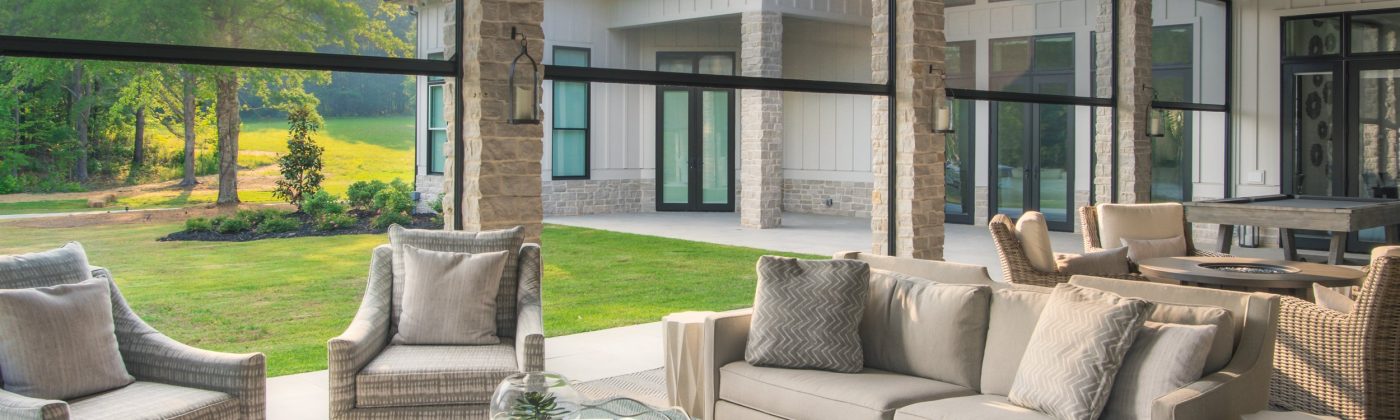
Motorized Screens for Patios & Porches: Benefits, Options & What to Consider
Motorized screens can make a porch, patio, outdoor kitchen or other covered living area much easier to use. Instead of manually moving a large screen, the system raises or lowers with powered operation, allowing you to add screening when you want it and open the space again when you do not.
For Georgia homeowners with wide porch openings, frequently used patios or outdoor spaces where convenience matters, motorized screens can be an especially practical option. But the right system depends on the opening, the material selected, how often the screen will be used and what you want it to accomplish.
This guide explains where motorized screens work well, how they differ from manual retractable screens, what screen materials are available and what to consider before installation.
What Is a Motorized Screen?
A motorized screen is a retractable screening system that uses a powered motor to raise and lower the screen instead of requiring manual operation.
When lowered, the screen can provide insect protection, shade or privacy depending on the material selected. When raised, the screen retracts out of the opening so the porch or patio can return to a more open-air configuration.
Motorized systems are often used across larger openings where manually handling a screen would be less convenient.
Where Do Motorized Screens Work Best?
Motorized screens can be adapted to a variety of covered outdoor living spaces. Common applications include:
- Covered patios
- Screen porches and open-air porches
- Outdoor kitchens and dining areas
- Large porch bays
- Poolside sitting areas
- Decks and terraces
- Large door or wall openings
- Selected commercial outdoor spaces
If you are comparing several ways to screen an outdoor area, our Porch & Patio Screens page provides a broader overview of fixed, retractable and motorized options.
Benefits of Motorized Porch and Patio Screens
Convenient Operation
The biggest advantage of a motorized screen is convenience. Large screens can be raised or lowered without manually moving the screen across the opening.
Depending on the selected system, controls may include a wall switch, handheld remote or compatible automation options. Available controls vary by product, so those features should be confirmed when selecting the system.
Insect Protection When You Need It
With insect mesh installed, a motorized screen can help reduce mosquitoes, flies and other pests while still allowing airflow through the porch or patio.
When insects are not an issue and you prefer a completely open view, the screen can be retracted.
Open Views When the Screen Is Raised
Unlike a fixed screen that remains across the opening continuously, a motorized retractable screen can disappear from the opening when it is not needed. This can be particularly useful around yards, pools, wooded properties or other areas where preserving the view is important.
Options for Sun and Privacy Control
Motorized systems can use different screen or shade materials depending on the goal. In addition to standard insect mesh, denser materials may provide greater sun, glare or daytime privacy control.
If sun and glare are the primary concern rather than insects, consider comparing the screen options with dedicated solar and privacy shades.
Motorized Screens vs. Manual Retractable Screens
Motorized screens and manual retractable screens serve a similar purpose: both allow screening to move out of the opening when it is not needed. The main difference is how the screen is operated.
| Consideration | Manual Retractable Screen | Motorized Screen |
|---|---|---|
| Operation | Moved manually | Powered operation |
| Smaller openings | Often practical | May be more system than necessary |
| Large or tall openings | May be less convenient | Often a strong fit |
| Frequent daily use | Requires manual adjustment | Convenient for repeated operation |
| Multiple panels | Each may require manual operation | Can simplify operation depending on system design |
For smaller, easy-to-reach openings, a manual retractable screen may be perfectly suitable. For larger porch or patio openings that are used frequently, powered operation can be much more convenient.
What Screen Material Should You Choose?
The motor controls how the screen moves, but the material determines what the screen actually does. Choosing the right material is just as important as choosing motorized operation.
Insect Mesh
Insect mesh is designed primarily to reduce mosquitoes, flies and other pests while maintaining airflow and visibility. It is a common choice for porches and patios where bug protection is the main goal.
Solar Screen Material
Denser solar-oriented materials can provide greater shade and glare control than standard insect mesh. The tradeoff is typically less airflow and reduced outward visibility.
Privacy Material
Privacy-oriented materials can reduce daytime visibility into a porch or patio. Privacy depends on lighting conditions, fabric density and viewing angle, so the same material may provide a different level of privacy after dark when the screened area is brightly lit.
The best approach is to choose the material around the primary goal rather than assuming the same screen should solve every problem.
Are Motorized Screens Worth It?
Motorized screens tend to make the most sense when their convenience solves a real problem.
They may be worth considering when:
- The porch or patio has large or wide openings
- The screens will be raised and lowered frequently
- The opening is tall or difficult to reach
- Several screen panels are part of the outdoor space
- You frequently entertain and want to change quickly between open-air and screened use
- Push-button operation is an important convenience
For a small opening that will rarely be adjusted, manual operation may be the simpler choice. The value of motorization depends on how the space is actually used.
What About Smart Home Controls?
Some motorized screen systems can support additional control or automation options, but these features vary by manufacturer and product.
Depending on the selected system, available options may include remotes, wall controls, scheduling or integration with compatible automation equipment. If smart-home compatibility is important to you, it should be discussed before the screen system is selected rather than assumed afterward.
Can Motorized Screens Handle Wind and Rain?
Motorized insect and solar screens should not be treated as storm protection, hurricane protection or sealed weather walls.
Outdoor screen systems should be operated according to the manufacturer’s recommendations, particularly during high winds or severe weather. Wind limits and operating guidance can vary by system and screen material.
For projects where additional seasonal weather protection is important, specialized materials such as clear vinyl may be available for certain applications. Those products should be evaluated separately from standard insect or solar screen material.
What to Consider Before Installing Motorized Screens
A successful motorized screen project depends on more than simply measuring the opening.
- Opening size: Width and height affect the type of system that can be used.
- Mounting surfaces: Columns, beams, ceilings and framing determine how the screen can be installed.
- Power access: Motorized systems require planning for the appropriate power source and controls.
- Primary goal: Determine whether insects, sun, glare, privacy or flexibility are most important.
- Screen material: Different fabrics provide different levels of airflow, visibility, shade and privacy.
- Furniture and traffic: Walking paths, grills, doors and outdoor kitchens should be considered when planning the installation.
- Control preferences: Determine whether wall controls, remotes or compatible automation features are important to the project.
Professional Installation Matters
Large retractable screens rely on proper measurements, alignment and installation for smooth operation. A professional installer can evaluate the opening, surrounding structure, screen material and operating requirements before selecting the system.
Custom installation is particularly important with wide porch and patio openings where the screen, tracks, housing and motor all need to work together correctly.
How to Care for Motorized Screens
Maintenance requirements vary by manufacturer, but a few basic habits can help keep a motorized screen system operating properly.
- Keep tracks, channels and the area around the screen free of leaves and debris
- Clean the screen material using methods recommended for the selected fabric
- Avoid forcing the screen if it encounters an obstruction
- Inspect the system periodically for visible damage or alignment issues
- Follow the manufacturer’s recommendations for operation, cleaning and severe weather
Avoid automatically lubricating tracks or moving components unless the manufacturer specifically recommends it, since maintenance requirements differ between systems.
Motorized Screen FAQs
Can motorized screens be installed on an existing porch?
Often, yes. Whether a motorized screen can be added depends on the opening, framing, mounting surfaces, available space for the housing and the electrical requirements of the selected system.
Do motorized screens keep mosquitoes out?
When fitted with insect mesh and fully lowered across the opening, motorized screens are designed to reduce mosquitoes, flies and other insects while maintaining airflow.
Are motorized screens good for large patios?
Large porch and patio openings are one of the situations where motorized operation can be particularly useful because a powered system eliminates the need to manually handle a large screen.
Do motorized screens provide privacy?
They can when equipped with an appropriate privacy-oriented screen or shade material. The amount of privacy depends on fabric density and lighting conditions.
Can motorized screens help with the sun?
Solar-oriented screen materials can reduce direct sun and glare while still allowing some airflow and outward visibility. For projects primarily focused on sun and privacy rather than insects, motorized solar shades may also be worth considering.
Are motorized screens weatherproof?
No. Standard motorized insect and solar screens should not be considered storm protection or a sealed exterior wall. Always follow the manufacturer’s recommendations regarding wind and severe weather.
Explore Motorized Screens for Your Georgia Home
Motorized screens can be an excellent way to add flexibility to a frequently used porch or patio, particularly when the space includes large openings that would be inconvenient to screen manually.
Screens of Georgia designs and installs motorized screens for patios, porches and outdoor living spaces along with manual retractable screens, fixed screens, solar shades and other custom outdoor solutions.
You can also compare all available screen and shade options or browse our completed project gallery for ideas.
Contact Screens of Georgia to discuss your porch or patio and determine whether a motorized screen system makes sense for your space.
